Automate the workflow.
Approve before act. Prove every step.
Governed workflow automation for regulated enterprises. Every action authorized by the OpenID AuthZEN standard before it executes. Every operation produces cryptographic proof. Every successful workflow promotable into reusable, governed automation.
The enterprise alternative to n8n, Temporal, and Camunda — for organizations where auditors ask questions your workflow tool can't answer.
The governance gap in workflow automation
Your operations team automates provisioning, onboarding, and integrations with workflow tools. Then auditors ask: who approved each action? What policy governed it? Can you prove what ran? And your workflow tool has no answer. Now AI agents are calling the same workflows — and the gap is about to get much wider.
Approved to run the workflow — but not the action
Most tools authorize "can you run this workflow?" — not "can you execute this specific action on this specific system?" Step-level risk goes uncontrolled.
Logs say what happened — not what was authorized
When regulators ask for evidence, log files aren't enough. You need proof that ties the policy decision to the exact operation that executed.
Agents calling workflows with no identity model
AI agents now invoke the same automations your team built. But your workflow tool has no concept of agent identity, delegation, or tool-level governance.
"It worked once" doesn't mean production-safe
Without promotion gates, versioning, and catalog controls, you can't safely turn a successful manual workflow into repeatable governed automation.
Real workflows, governed end to end
These are the kinds of workflows running through the engine — each one with per-action authorization and a complete proof chain.
Approve before act
Every workflow step authorized by the OpenID AuthZEN standard before it executes. Not workflow-level permissions — action-level authorization via an open standard PDP. If policy says escalate, the workflow pauses for human review and resumes when the decision is made.
Prove every step
Every operation produces a cryptographic receipt linking the authorization decision to the action that ran and the result it produced. Auditors get evidence in seconds — not a spreadsheet assembled over three days.
Promote to production
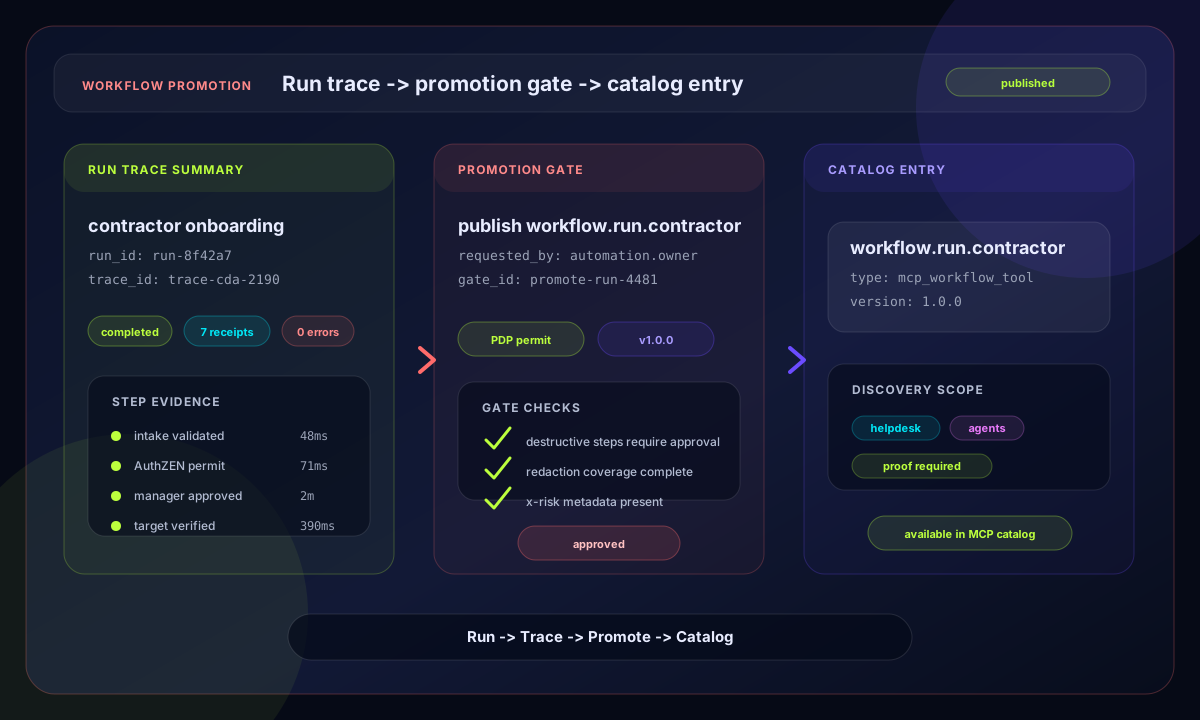
One successful governed run becomes a versioned MCP tool that any authorized team, agent, or system can invoke through a standard tool call. Promotion gates and policy-scoped discovery ensure it meets governance standards before it goes live.
From one good run to production automation
The promotion loop turns "it worked once" into a governed MCP tool. Run a workflow. Capture the evidence. Promote it to the catalog as a versioned MCP tool. Now any authorized team, system, or agent can invoke it through a standard tool call — with the same per-action authorization and proof chain every time.
Execute workflow
with full governance
Receipts + evidence
for every step
Approval gate
version the workflow
Governed MCP tool
invoke from anywhere
What changes for your organization
Every workflow produces a complete proof chain: who requested it, what policy authorized it, what ran, what the result was. Auditors pull evidence instantly instead of assembling spreadsheets for three to five days.
AI agents invoke workflows through governed tool calls with full identity and delegation chains. They never get direct system access. Policy decides what they can do. Human approval gates catch anything sensitive.
Zero-Shot AI workflow synthesis: CDA-enriched tool schemas carry enough context for the engine to compose governed workflows from a natural-language description. No visual designer, no workflow engineer. (Patent pending)
A workflow that succeeds once — with receipts and trace — gets promoted into a versioned, governed MCP tool in the enterprise catalog. Any authorized team or agent invokes it through a standard MCP tool call. No rebuild. No separate approval process. The same governance applies every time it runs.
Zero-Shot AI workflow engine (Patent pending)
Traditional workflow tools require a workflow engineer, a visual designer, and weeks of build-test-deploy. The Zero-Shot engine turns a plain-language description into a governed workflow — because every tool already describes itself.
Why it works: CDA-enriched tool schemas
Every MCP tool in the catalog carries CDA x-fields — metadata extensions that go beyond standard parameter schemas. x-suggest tells the engine what valid values look like. x-normalize ensures inputs are canonical. x-risk classifies the operation's risk level. x-redact marks sensitive fields for proof-chain privacy. These self-describing tools give the engine enough context to compose multi-step workflows without prior training on any specific tool.
What the engine produces
From a natural-language prompt, the engine synthesizes a graph-based workflow with typed steps, each bound to a real OperationRef in the catalog. Every step carries its own authorization binding — the OpenID AuthZEN PDP evaluates it before execution. Pause gates insert automatically where risk requires human review. The output isn't a draft — it's a governed, executable workflow ready to run with full proof-chain support.
Workflow engineer → visual designer → map tools → add approval gates → test → deploy → weeks
Describe intent → engine composes → authorization binds → run with governance → seconds
One good run → governed MCP tool in the catalog → any team or agent can invoke it
How governance works at every step
Three mechanisms work together: policy authorization decides what's allowed, safe pause/resume handles approvals without breaking the workflow, and cryptographic receipts prove what happened.
Policy authorization
Every step sends an authorization request to the AuthZEN PDP — the OpenID Foundation standard for fine-grained authorization: who is acting, what action, on which resource, in what context. The PDP returns Allow, Deny, or Escalate — with constraints and obligations. Open standard, no vendor lock-in.
Per action. Not per workflow. Not per run.
Safe pause and resume
When a step requires human approval, the workflow pauses with a durable contract — not a chat popup. The approver (human or agent) resumes with a structured call. Replay-safe, tamper-evident, exactly-once execution.
This is how agents get human-in-the-loop without breaking the workflow.
Cryptographic receipts
Every tool call produces a receipt linking the authorization decision to the operation and its result. Every workflow run produces a trace aggregating all receipts. Stored immutably. Delivered to auditors on demand.
Receipts, not logs. Evidence, not records.
Technical deep-dive Authorization, pause/resume, and proof chain internals
Per-Action Authorization
Each step sends a structured request to the AuthZEN PDP — implementing the OpenID Foundation's AuthZEN specification for fine-grained, interoperable authorization: subject (user or agent identity + delegation chain), action (semantic OperationRef), resource (target system + specific object), and execution context. The PDP returns Allow (with constraints like budget caps, TTL, rate limits), Deny (with the triggering policy rule), or Escalate (triggering the pause protocol for human review).
WAITING Protocol
A pause response includes: required_action (choice / form / approval / confirm), mcp_request_format with exact resume instructions, a stable fingerprint (SHA-256 for audit joins), and retry_policy. Resume enforces: state_version (optimistic concurrency), idempotency_key (dedupe retries), and a single-use execution token (atomic Redis SADD). Zero double-writes under retry.
Proof Chain
Each ExecutionReceipt captures: subject identity, OperationRef, authorization decision hash, request payload (redacted via CDA x-redact), response, and timestamp. RunTrace aggregates all receipts for a workflow run. Both stored in ClickHouse. Every receipt includes the compiled_profile_version — the exact configuration state at execution time — so behavior changes are traceable.
Why not just use your existing workflow tool?
| Capability | EmpowerNow | n8n / Temporal / Camunda | Workato / Tines |
|---|---|---|---|
| Per-action policy authorization | OpenID AuthZEN | No | Proprietary |
| Cryptographic proof per operation | Yes | Logs only | Logs only |
| Durable human-in-the-loop | Yes — protocol-level | Manual | Manual |
| Agent identity and delegation | Yes — full chain | No | No |
| Promote run to governed catalog | Yes | No | No |
| AI workflow synthesis from natural language | Zero-Shot (patent pending) | No | AI assist only |
| Replay safety (zero double-writes) | Yes | Partial | No |
| Workflows published as MCP tools | Yes — governed catalog | No | No |
Build the connector once. Use it everywhere.
Create or import a connector without code. Every action automatically becomes three governed surfaces:
Call it directly, authorized and receipted
Drag it into the visual orchestration designer
Agents discover and invoke it safely
One definition. Three surfaces. Same authorization. Same proof chain. See the Connector & Tool Factory →
Also the engine underneath SAP, IGA, and ARIA
This isn't only a standalone product. The same engine powers SAP connector provisioning, IGA identity lifecycle, and ARIA agent tool calls across the platform. When you buy standalone, you get full design, publish, and governance rights over the engine that already runs everywhere else.
See a governed workflow go from prompt to production
Describe a workflow. Watch it execute with per-action authorization. See the proof chain. Promote it to the catalog. That's the demo.